Just purchased this from Amazon @ a great price. I use the 5D Mark II and wanted something small, light and fast. I like primes due to their lightweight and the face they are faster and sharper than zooms. Previously I owned the 28mm f/1.8, which I liked a lot, but this one is better. There is so much clarity and details in the pictures, more than I notice with my other lens. It is sharp and 2.8, so you can shoot wide open. It is even sharper @ f/4 and due to the IS, you can shoot some extremely low shutter speeds. This is going to take over as my indoors lens, taking over my Canon 50mm f/1.4's spot. Very glad I decided to go with this one. I also picked this up to go with it it works great and is much less that Canon's. Rinbowimaging Lens Hood for Canon EF 24mm f/2.8 IS USM Lens & 28mm F2.8 IS USM lens, replaces Canon lens hood EW-65B

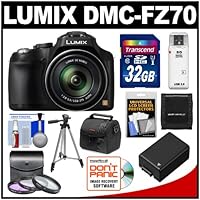
Panasonic Lumix DMC-FZ70 Digital Camera (Black) with 32GB Card
At a price only slightly higher than just the camera, Cameta Camera adds some useful items. Let me briefly comment on each:
Kit includes:
♦ 1) Panasonic Lumix DMC-FZ70 Digital Camera (Black) -Reviewed in depth by others. It's a good 60x superzoom camera if you don't expect more than its tiny 1/2.3" sensor can deliver. A few similar cameras may produce slightly clearer pictures, but the FZ70 offers wider wide angle. That's unique.
♦ 2) Transcend 32GB SecureDigital (SDHC) 300x UHS-1 Class 10 Memory Card -Not the fastest card but fast enough for this purpose.
♦ 3) Spare DMW-BMB9 Battery for Panasonic -Charged spares are always nice to have in reserve.
♦ 4) Zeikos 50" ZE-TR26A Compact Travel Tripod -The equivalent version I got was Vivitar, a very lightweight tripod that would be challenged by a breeze. It can support the camera for group photos indoors, but don't expect a stable platform for 1200mm telephoto shots outdoors.
♦ 5) Zeikos 3-Piece Multi-Coated Glass Filter Kit (55mm UV/FLD/CPL) -Yes, it's glass, but the CPL filter shows no evidence whatsoever of polarizing light. It's more like a weak neutral density filter. Disappointing: CPL was the only filter I wanted, and it doesn't work. The box says that filters are multi-coated but I doubt it, since they show strong surface reflections. This is a dud.
♦ 6) Precision Design PD-C10 Camera/Camcorder Case -Simple but fully functional. It fits the camera and a couple of small accessories, such as the charger and the spare battery.
♦ 7) Precision Design USB 2.0 SecureDigital (SDHC) High-Speed Memory Card Reader -The version I got was made by Xit Photo. It measures only 1.5" and works well.
♦ 8) Precision Design 5-Piece Camera & Lens Cleaning Kit -Should be useful.
♦ 9) Precision Design Universal LCD Screen Protectors -You have to cut those to size, but they work well to protect the LCD screen from scratches.
♦ 10) Precision Design Memory Card Storage Wallet -Makes it slightly harder to lose memory cards.
♦ 11) ImageRecall Digital Image Recovery Software -Not useful to me, but one can download this software if needed. The Transcend memory card included a link to something similar.
My conclusion? The rating is mostly based on camera performance, which is very good, but can't compete with larger sensor cameras. What makes this camera special is the zoom: it delivers tremendous versatility in a relatively small package (size comparison to DSLR cameras with similar focal length lenses are downright funny). Ergonomics, camera settings & operation work for me. Image quality is adequate for this type of camera.
The rest of the kit is a mixed bag, but justifies a slightly higher price. Overall, I'm happy with the camera case, extra battery, memory card & card reader, screen protectors, and even the cleaning kit. These items justify the $25 premium (including shipping) over the camera alone. However, the filters and the tripod are simply inadequate.

Kit includes:
♦ 1) Panasonic Lumix DMC-FZ70 Digital Camera (Black) -Reviewed in depth by others. It's a good 60x superzoom camera if you don't expect more than its tiny 1/2.3" sensor can deliver. A few similar cameras may produce slightly clearer pictures, but the FZ70 offers wider wide angle. That's unique.
♦ 2) Transcend 32GB SecureDigital (SDHC) 300x UHS-1 Class 10 Memory Card -Not the fastest card but fast enough for this purpose.
♦ 3) Spare DMW-BMB9 Battery for Panasonic -Charged spares are always nice to have in reserve.
♦ 4) Zeikos 50" ZE-TR26A Compact Travel Tripod -The equivalent version I got was Vivitar, a very lightweight tripod that would be challenged by a breeze. It can support the camera for group photos indoors, but don't expect a stable platform for 1200mm telephoto shots outdoors.
♦ 5) Zeikos 3-Piece Multi-Coated Glass Filter Kit (55mm UV/FLD/CPL) -Yes, it's glass, but the CPL filter shows no evidence whatsoever of polarizing light. It's more like a weak neutral density filter. Disappointing: CPL was the only filter I wanted, and it doesn't work. The box says that filters are multi-coated but I doubt it, since they show strong surface reflections. This is a dud.
♦ 6) Precision Design PD-C10 Camera/Camcorder Case -Simple but fully functional. It fits the camera and a couple of small accessories, such as the charger and the spare battery.
♦ 7) Precision Design USB 2.0 SecureDigital (SDHC) High-Speed Memory Card Reader -The version I got was made by Xit Photo. It measures only 1.5" and works well.
♦ 8) Precision Design 5-Piece Camera & Lens Cleaning Kit -Should be useful.
♦ 9) Precision Design Universal LCD Screen Protectors -You have to cut those to size, but they work well to protect the LCD screen from scratches.
♦ 10) Precision Design Memory Card Storage Wallet -Makes it slightly harder to lose memory cards.
♦ 11) ImageRecall Digital Image Recovery Software -Not useful to me, but one can download this software if needed. The Transcend memory card included a link to something similar.
My conclusion? The rating is mostly based on camera performance, which is very good, but can't compete with larger sensor cameras. What makes this camera special is the zoom: it delivers tremendous versatility in a relatively small package (size comparison to DSLR cameras with similar focal length lenses are downright funny). Ergonomics, camera settings & operation work for me. Image quality is adequate for this type of camera.
The rest of the kit is a mixed bag, but justifies a slightly higher price. Overall, I'm happy with the camera case, extra battery, memory card & card reader, screen protectors, and even the cleaning kit. These items justify the $25 premium (including shipping) over the camera alone. However, the filters and the tripod are simply inadequate.

Panasonic Lumix DMC-FZ35 12.1MP Digital Camera with 18x POWER
As a serious amateur, I've been fortunate enough to own a number of point and shoots including Panasonic, Fuji, several Nikon's, & a couple of Canon's. All have had their strong points and I'm not a brand loyalist by any means, but after a couple of weeks, I must say I absolutely love this camera.
My first impressions were ones of pleasant shock. The camera seemed smaller than in the pictures and if it seemed smaller, it seemed doubly more so in terms of weight. Compared to my SLR this thing is an absolute lightweight but very well built and certainly heavier than the smaller 'in your pocket' point and shoots. A great balance...although I wouldn't want to drop it. Some strategically placed silicone on the housing would make this a bit more rugged without much if any impact on cost. Powerup is about as fast as you can bring the camera up to your face amongst the best of the point and shoots. Controls are easy to use and I like the mini joystick for making on the fly adjustments in manual and scene modes. The menus are fairly well laid out although some items I had to resort to the manual to find their location for the first time.
The iA or Intelligent Auto function gave consistently above par picture quality, although I was always able to tweak it better myself (this could have been as much preference as anything). The AVCHD and HD movies worked absolutely flawless with my Transcend 16 GB SDHC Class 6 Flash Memory Card TS16GSDHC6E [Amazon Frustration-Free Packaging]. (NOTE:Make sure you lowlevel format these SDHC cards a COUPLE of times BEFORE first use). I do wish that you could use the normal shutter release instead of the dedicated movie button on the back face when in movie mode. I kept forgetting and tried to stop the movies using the shutter button instead of the record button. Minor nuisance, but will be overcome as I get my brain wrapped around the change in button locations.
The battery worked well past 300 stills and about 35 clips, so I am very pleased with it with the LCD display being used for most of the shots. I purchase another spare battery;Lenmar DLP006 Lithium-ion Digital Camera/Camcorder Battery Equivelent to the Panasonic CGR-S006A Battery, also available here at Amazon, and it appears to be working about as well as the original Panasonic (a great buy). The EVF or Electronic View Finder was very handy, although most of the overlaid information is very hard to distinguish in the small EVF. I CAN'T BELIEVE PANASONIC DIDN'T INCLUDE A RUBBER BOOT FOR THE EVF! Please someone, anyone, make it as an accessory.
The EZ or Extra Zoom function is quite handy. Using this feature, you can shoot at lower resolutions and get more effective zooming power out of the camera...over 30x and it works very well. The LCD screen is clear and crisp, but its performance in high ambient light is about average. Thank goodness for the electronic view finder mentioned above.
Image stabilization is the absolute best amongst my camera collection and is especially noticeable in low light and full zoom. I was pleasantly surprised how well I could take indoor pictures at night with a simple tweak of the exposure. Far better than any of my other point and shoots, although nowhere near my SLR.
The standard 3picture burst mode was fairly standard and unimpressive, but the 10pics per second for speed priority and 6 pics per second in image priority burst mode worked well for catching difficult shots like geese landing on the water and children jumping out of swings, but I still wish the resolution and picture quality was better in these modes. Still, for a point and shoot, it's ability to catch the fast action is at the top of it's class.
The lens cap interferes with zoom, but the camera will kindly remind you that you have left it on with a 17,000 volt discharge...just kidding...it will tell you on the LCD screen.
UPDATE: A new megazoom runoff was conducted by Digital Photography Review in June of '07 and can be seen here: or you can cut to the results here:
To say the FZ35 stacked up well would be an understatement, but as they point out in the above review, you will likely not be disappointed with any of the other fine cameras in the pack. The review, however, will help you to pick one that works best for your needs and preferences. (I'm still super happy and winning contests with my amateur photos).
LIKES: Ease of use, picture quality, zoom and extra zoom, HD movie, lightweight, stop action. BEST Point and Shoot I've ever owned ! ! !
DISLIKES: (all minor) No eyepiece boot for EVF, lens cap interferes with zoom, tripod mount interferes with battery/memory door when in use. Only 10 sec. max on the built in timer.
Yongnuo Speedlite YN560 Flash for Canon, Nikon Cameras


List Price: $99.99
Sale Price: $59.99
Today's Bonus: 40% Off

I haven't shot enough with it to determine consistency, but I'm pleased so far. Flash is a bit large for the output, but it is still decent. I did some test shots and was getting f8 at 18 ft. This tells me that the GN is just about 144. The specs put it at just 58. (Maybe that was supposed to be meters and not feet). This is almost as good as I got from the Sunpak PZ42XC at full on manual.
Build is similar to the Sunpak flashes. Swivel and bounce feel no less solid and click into place just fine without shifting. The built in diffuser AND mini bounce card are nice although small. My sunpak PZ42XC doesn't have that. There is a PC sync and a power supply connection on the side which my sunpak doesn't have either. Then there is the optical slave which works well with two levels of sensitivity and of course my sunpak lacks that as well.
With all of that said, this flash isn't for just anybody. This is just a plain dumb manual flash without TTL or even a thyristor. THERE IS NO AUTO FUNCTION. If your intent is to use this as a camera mounted flash for candids, forget it unless you know how to manually setup for every shot by adjusting your aperture as needed. It is not intended for that purpose.
The flash came with a base that has a threaded hole in the bottom so it can be mounted to a stand. It would do a terrific job providing fill or backlight capability. It swivels 180 degrees and straight up so bouncing into an umbrella or through a diffuser while the slave sensor faces forward for a stationary photo shoot are ideal uses of this flash. So is placing it behind a subject for a backlight. My Lumiquest gel holder fits very tight due to the large flash head, but it fits.
The controls and lights on the back seem a bit confusing and the manual isn't a lot of help since the translation from Chinese to English is about the same quality as you get from Google translate..... I was able to figure it out but it took some time experimenting with the unit.
Recharge is quick even at full power. I was very impressed. Of course it has less output than the Sunpak and uses the same number of batteries but still, I was pleased.
One other note. When i first tried to turn it on it wouldn't do anything and I was immediately afraid it was DOA. I found that to turn it on, you must hold the on-off button for a couple seconds. When you press it down, the lights on the bar progress from left to right and if you don't hold it down till the lights get to the far right, it just shuts off. Awkward, but easy to deal with if you are aware of it.
Altogether, I'm quite pleased with what I have assuming it lasts a a while. The build seems solid so I'll just have to wait and see. I'm confident enough in the product that I'm going to buy a second one so I can have one for fill and the other for a backlight for impromptu studio shots.
If you need a slave flash with some power and manual controls I really think this is the best thing out there. Almost everything else in this price range is a single power or auto-flash without the ability to make manual output adjustments. You can get this output with no slave, the slave with no manual,or you can spend twice as much. But if you need a speedlight with auto functions for camera mounted shots, get something with auto functions.
Sony Cyber-shot DSC-HX20V 18.2 MP Exmor R CMOS Digital Camera
First, I didn't buy this from Amazon. I was walking around my local electronics store and played with it and bought it. Overall this is a good improvement from the HX9V. Few months ago, I purchased a Canon PowerShot SX260HS for $349.00 (you can get it for $299 now) and it's one of my favorites. How does the SX260 compare to this camera?
Resolution:
The Sony is an 18MP camera, Canon is 12MP.. besides the bigger JPG size, can't tell the difference both look decent when printing on 11x17..
Size/Weight:
Both are nearly identical. The Canon weigh 8.5oz, the Sony 8.8oz
Zoom:
Both have 20x optical zoom, but in comparing pictures, it looks like the Canon's optical "zoom" is closer. Canon has a combined 81x digital zoom, Sony's 40x. Canon's 81x combined digital zoom sounds nice, but there's so much noise that it may not be worth using. With the Sony, even at 40x the picture is still acceptable.
Flash Control:
With the Canon, you can adjust the flash power, with this, you can't....major disappointment especially for a camera that cost $399.00
Menu/Navigation/Ease of use:
This is more of a preference. I used Canon and I used Sony; personally I like the Canon because I think it's more logically ordered
Flash position:
Both are pop up flash. I know it's going to require people to change their grip but I kind of like the pop up flash.
AWB (Auto White Balance)
This is one area that I think Sony made a big improvement with this camera. The AWB on the HX9V was terrible and required manual tweaking. The Canon does a very good job with the AWB. I used this Sony for about a week and went through about 500 shots. The AWB has NOT missed it's mark; not even taking photos indoor with florescent lighting that can cause yellow tinting with improper AWB.
Speed:
One of the reasons why I got rid of the HX9V was because of the slow processing speed. This camera, the image processor performance has improved quite a bit. With the HX9V, it would take up to 6 seconds to save/process images. With this, I think the longest was 3 seconds. The speed is on par with the SX260.
Picture Quality:
In auto mode, the Sony does an excellent job reproducing accurate colors. The colors are more natural looking, but on occasion (especially in landscape mode) the blue and red looks amplified.
Manual Controls:
This camera DOES NOT have a "Shutter Priority" and DOES NOT have a "Aperture Priority" mode! The Sony's manual mode is practically useless. Sony what were you thinking!!! Canon has the Aperture and Shutter mode, and the Canon's manual mode give you more control although it doesn't compare it with a DSLR
ISO Speed:
This Sony goes up to 12800 AMAZING!!!... the Canon comes no where near this..
3D Feature:
I don't have a 3D TV so can't comment on it. I did try to take some 3D pictures (supposedly you can now view 3D pictures on the LCD screen; something the HX9V was not able to do) but I don't think it's working correctly, or maybe I just can't tell the difference. The Canon has no such feature.
Video Quality:
Sony's video quality hands down. This beast is fast capturing full HD. One of the thing I loved about the HX9V was the video quality. It was perfect for those quick moment. This Sony looks just as good if not better.
Memory Card:
The Sony has built in memory, it's not much but better than nothing. I used a Patriot SDXC and a SanDisk SDXC, performance identical. The SanDisk cost twice as much as the Patriot because it's suppose to be faster. I can't tell the difference, and neither can my cameras. Both camera recommends Class 6 of higher, but if you plan to record video, go for the Class 10. A 64GB card can capture close to 10,000 picture.
Battery Life/Charge:
With the Canon, I got about 250 shots before the battery indicator started flashing. The Sony was about the same based on mixed use. One thing about the Sony is that it DOES NOT come with a battery charger. But, you can charge it with a micro USB able. Call me old fashion but if you're going to charge $399 for a camera give me a battery charger! The Micro USB charge may not be a bad thing if they didn't put the port on the bottom of the camera. So when you're charging the camera has to lay on it's side. As others have commented, you can buy a decent aftermarket charger for under $5.00.
Live Mode:
The Canon has a dedicated "live mode" that allows you to adjust the color on the LCD screen before snapping a shot; kind of like a "what you see is what you get". Sony has this built into their auto mode. Press the down navigation wheel to activate this feature.
Scene Modes:
With the HX9V, the scene modes were terrible; the difference were so subtle. This Sony is a HUGE improvement. With the Sony, you can see there IS a difference now. I am especially impressed with the "food" scene. With this mode, when you take a picture of food, it's suppose to enhance the color to make it more appealing. With the HX9V, it's a gimmick, but with this it's a 180 degree improvement. My best description of this is when you see those professional pictures of food at restaurants, this Sony can produce that type of quality. Canon does a good job with most of the scenes, but I prefer the Sony now. The Auto and Super Auto mode works great. For the regular outdoor or well lit environment the Super Auto won't be much difference. For those complicated lighting situation, the Super Auto does a better job. But the Super Auto mode will take about three seconds to process the image. With the scene mode, just because its designated as a "food" mode does not mean you just use it to take pictures of food. I used the "food" mode to take other beautiful indoor pictures that are not food (without flash) at fancy steak houses, and they came out beautiful. The difference with this mode (and the ISO mode) is that the food mode enhances the colors a notch making them appear more vibrant.
Defcocus Mode:
One of the feature I like is the defocus feature. This is one feature that distinguish this camera from other Point and Shoot. With the more expensive DSLR camera, you can take a picture where the portrait is in sharp focus but the back landscape is blurred. Sony does a decent job with this (in fact, I haven't seen this feature on any other brand camera). This feature does not work with the flash because what the camera does is take two shots and combine them to create this effect. But do note that when you use this mode, the LCD screen will tell you how far the subject should be and if you ignore it and take a picture, the Defocus will not work (you still get a decent picture though)
LCD Screen:
Both units have a 3-inch LCD screen, but I think the Sony camera has a sharper, clearer display.
GPS:
Both units have GPS, I haven't used it on either units though.
Camera Body:
The Canon has a more solid feel to it. The HX9V had an "expensive" look and feel. With this Sony, it's just all black and nothing to distinguish this camera for others. The Canon has that expensive camera look and feel, but this Sony does not. It looks plain and boring.
Cost:
The Sony cost $399, Canon cost $299.00, $100 difference.. Is this camera worth $100 more than the Canon SX260HS? You decide...
Sony, if you want me to rate this 5-Star, please do the following:
1. Put the Shutter and Aperture mode back in this camera
2. Give me flash exposure control
3. Give me a battery charger
4. And, give it to me for no more than $349
Canon Powershot SX510 HS CMOS 12.1MP 1080p 30x Optical Zoom

List Price: $319.99
Sale Price: $259.95
Today's Bonus: 19% Off
I have bought this camera for my granddaughter for a Christmas present.
I had already purchased when she told me this was the camera she wants.
Thank Goodness.
Had an issue with shipping and seller was very prompt about fixing the problem
I will buy from them again!!
Zeiss ZE Planar T* 50mm F/1.4 Lens for Canon EOS Cameras
I fell in love with the lens on my old Rolleiflex camera, a 75mm Zeiss planar, which on a medium-format camera is about the same field of view as this 50mm planar on my 5D Mark II. It has that magical, hard-to-describe 3D look. Super-sharp in the middle, softer on the edges. Wait, is it softer in the corners, or is the contrast just lower? Beyond my technical expertise. But it looks fabulous.
Some say it is soft / not as sharp as one would expect. My bet is that they just didn't nail the focus (more on that below). I don't shoot architecture or other technical work, I mostly do environmental portraits. I want it soft in the corners. So I'm not even looking for edge sharpness.
Also, you can really fine tune the focus more spin of the wheel to change the focal point compared to a standard Canon lens. Which should make it great for video, although I've only done a little with that.
I suspect that some people try these and then don't keep using them; they do pop up on ebay and other places used quite often. There is nothing wrong with the glass. Zeiss has mastered that. But if you want to shoot wide open, or close, you have to be very good at manual focus. I have 20/10 or even 20/5 vision in my right eye and I still usually take 3 images to make sure my subject is in focus when shooting at f2 or wider. Or that was the case until...
They say the lens "out-resolves" the focusing screen in your camera. That means on a standard Canon 5D Mark II for example, the focusing screen is only capable of displaying f/2.0 or narrower in the viewfinder. You can't see the depth of field of f/1.4. So you really can't manually focus, visually anyway, without changing focusing screens. I installed the Canon EgS focusing screen in my 5D2, a roughly $40 and 2 minute process, and that does make accurate focusing, quickly, much easier. The EgS will show you f/1.0. I recommend trying this screen with a lens like this.
Also, keep in mind that although the camera can't drive the lens to autofocus, the AF points in your viewfinder will still light up when the image is sharp. Pick a focal point, press the shutter button down half way, spin the focus on the lens, and when the AF point lights up, you know you have accurate focusing. This is called Autofocus-assist. Since some cameras, including the Canon 5D Mark III, don't have interchangeable focusing screens, this is the method to rely upon for shooting with a very wide aperture on manual focus lenses.
There is pretty heavy vignetting at f1.4. By f2 its not that noticeable. But wide open you lose almost a stop of light due to vignetting. I think it looks great, but it is surprising at first. I doubt you'll have that effect with a less than full frame sensor.
Bottom line I love it. The contrast, sharpness, bokeh, and color rendition are amazing. I use this and a 70-200 IS II to cover most scenarios. Both incredible. This Zeiss just takes a little more time, but the results are worth it. I'm in medium format quality territory with the Zeiss the images are that fine. If I am walking out the door to take photos of I don't know what, this is my favorite lens.
If you are looking at a 50mm I guess the question is which one to buy. This is better build quality and better glass than the Canon 1.4, and obviously more money. I admit, most casual viewers won't know the difference between an image taken with a $350 Canon lens and a $700 Zeiss lens. The Canon 50mm 1.2 (L) is incredible, but I'm not sure it's better in image quality than the Zeiss maybe, I haven't done a head-on test but you pay a TON more for the Canon, which admittedly gets you autofocus (a big deal), and from 1.4 to 1.2. $ aside, I like the Zeiss, unless autofocus is a must.
No Canon-branded lens I have tried feels this good in the hand. Zeiss has solid metal everything, weighty, excellent construction.
p.s. I also rented both the 28mm Zeiss and 21mm Zeiss for a few days, and had the same reaction.
Follow Up -
The (all-metal) lens hood has a tension ring of sorts and mine got out of place, making it impossible to keep the hood on. I contacted Zeiss support and they emailed me back in 2 hours with instructions on how to fix it. A small screwdriver and 20 seconds and it was fine again. I would have preferred the problem never happened, but the service and serviceability of the Zeiss product still leaves me very satisfied.