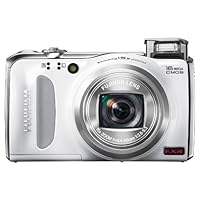
Fujifilm FinePix F505 16 MP CMOS Sensor and 15x Optical Zoom

Fujifilm FinePix F505 16 MP CMOS Sensor and 15x Optical Zoom Digital Camera with 4 GB Class 10 SD Memory Card
Customer Ratings: 4 stars
Buy Now
I love this camera so far. I bought it for a photography class I am taking next semester and have already used it more than I thought I would

Pros:

Comes with a free 4 Gb SD card

Has a GREAT picture, which is really the only important thing! The picture is better than my grandmas fujifilm that she paid $400 and I only paid $160

Has lots of different settings. When you put it on advanced it has a seamless panoramic setting. most panoramic settings you have to take three pictures and try to line them up just right and you always end up with two lines down the middle of your picture but this one you just pan the camera and try to stay level and then it calibrates the rest of it and blends it together and it looks seamless.

The EXR setting is amazing! the first day I got it my grandma had me take a whole bunch of pictures of a house she is selling and she needed inside and out. Different areas of the house were lighted different and it didnt matter, the EXR figured out the best setting it needed to be on to get the best picture and went there! the best part was that it could detect whether you were outside or not and it had the same quality picture everywhere. it didnt let so much sunlight in that it blared out the picture, and in low light it didnt turn out dark at all!

Its quite light weight for its size, but is heavy and sturdy enough that it doesnt seem chinsy

Another little thing that doesn't really matter much is that when you turn it on it seems all techy and futuristic :) the flash pops up and the lens covers snap inside and it makes a cool little noise. Its not needed, but appreciated by nerds like me :)

Cons:

I really havent found any yet. The only thing that MIGHT be one is that the scroll wheel is super sensitive. Im sure that there is a way to change that, I just havent looked for it yet. Its easy to scroll past the picture you were looking for but its not a big deal.

If I find anything big that I dont like about this I will update the review, but for now I love it

Really I would recommend this to anyone who isnt a total professional and wants really simple great looking pictures without having to lug around a giant SLR.

UPDATE:

This little camera is great. It takes pictures that are as good as the Canon Rebel a girl in my class has! The details of this camera are amazing. It has the same amount of pixels as the Nikon Dx5100 (or something like that) Another thing that I like is that the battery lasts a long time. I have only had to charge it once since I got it several weeks ago. There is still nothing that I can find wrong with this. The pictures that are coming from this are so good that I had someone ask me to take their engagement pictures.

UPDATE 2:

So I thought it was worth noting that I just dropped this camera. I was walking my dog and it was in my hoodie pocket and he jerked on the leash and it came out and landed on concrete. It landed screen down and the only damage that I have found is a little bit of paint chipped on the corner. Really happy with the sturdiness of the camera so far and I still love it.

Another thing that might be worth noting is that the word "fujifilm" below the screen is beginning to wear off a little bit but that in no way effects its performance so it isn't that big of a deal

If this was helpful I would really appreciate you taking a few seconds to hit the helpful button above. thanks :)
Click Here For Most Helpful Customer Reviews >>

Tamron AF 18-270mm f/3.5-6.3 VC PZD All-In-One Zoom Lens

Tamron AF 18-270mm f/3.5-6.3 VC PZD All-In-One Zoom Lens for Canon DSLR Cameras. Includes: 3 Piece Filter Kit, 4 Piece Macro Filter Set, Lens Hood, Lens Cap Keeper, Lens Cleaning Pen & Starter Kit
Customer Ratings: 4 stars
Buy Now
I was very pleased with this product. The only reason for four stars is that the lens circumference is 62mm but sent adapter and filters that are 72mm and no lens cover for this filter adjustment which means I have to remove the adapter and filter to use the 62mm lens cover and/or now have to purchase a 72mm lens cover.

Click Here For Most Helpful Customer Reviews >>

KOMPUTERBAY 64GB Professional COMPACT FLASH CARD CF 1000X

KOMPUTERBAY 64GB Professional COMPACT FLASH CARD CF 1000X 150MB/s Extreme Speed UDMA 7 RAW 64 GB
Customer Ratings: 4.5 stars
Buy Now
I bought this to do RAW video recording using Magic Lantern on the Canon 5D Mark III. It doesn't benchmark as high as some of the other 1000x cards, but it handles the RAW video fine. I can record up to 1920x1152 without dropped frames on a May 30th build of Magic Lantern. Aligning the partition on the card did boost the benchmarks a bit, but it didn't translate to being able record any higher resolution video.

For stills, in burst mode, I get about 24 frames before the buffer runs out and the shutter slows down. The Transcend 400x I replaced hit about 14 frames before slowing.

So far no quality issues and the price is fantastic compared to the more recognizable brands.

Click Here For Most Helpful Customer Reviews >>

LG Electronics NB4530B 47-Inch Slim Sound Bar With Wireless

LG Electronics NB4530B 47-Inch Slim Sound Bar With Wireless Sound Bar and Bluetooth
Customer Ratings: 4.5 stars
List Price: $449.99
Sale Price: $449.00
Today's Bonus: $0.99 Off
Buy Now

I bought this soundbar because of its low profile. At 2 1/8" inches with the 19mm foot attached, it was the perfect height to match with my Vizio M series 47" TV which I have in an entertainment center. I needed a sound bar that would fit under my TV on its stand without blocking the remote sensor on the bottom left corner and without covering part of the screen. I could not simply raise the TV as it fits on its stand perfectly in the space I needed to put it in and I did not want to raise the shelf above it. Most sound bars are 3"-4.5" tall and more suitable to wall mounting and this just was not going to work for me. I considered models that could be disassembled into L-R or L/C/R components for mounting at the side, but, none of them appealed to me.

This LG NB4530B is the prefect fit under my TV without blocking anything. Its slim profile makes it appear as if it were part of the TV. It works great with HDMI out connected to my HDMI ARC TV input and the TV remote volume buttons control the sound bar when connected this way. I have since connected it via optical cable as I have combined all of my A/V components with a URC-R40 universal remote control and I like the way it all works via optical connection a little better.

Sound wise, this thing blows away the TV speakers. Well, duh, who would buy it if it didn't? The clear voice setting is particularly appreciated with DVDs and Blu-Rays; otherwise, I just set it to bypass and this works great for everything else. The wireless subwoofer integrates seamlessly and, since I have it hidden away behind the open end table by my couch, it is not highly visible. The low frequency sounds from the subwoofer appear to be coming from the sound bar in the front.

Of course, this is not a replacement for a 5.1/7.1 surround system, but, it does a very admirable job with Dolby 5.1 and DTS soundtracks. The sound is really quite good from this unit. Friends and family who have listened to it have considered purchasing one instead of a wired 5.1 surround system. It certainly eliminates all the wire and speaker clutter if aesthetics and space saving are more valued than true surround sound.

With a variety of inputs and sound effect choices, this is a great sound bar choice, particularly if a low-profile unit is needed as in my situation.

The current Amazon price for this unit ($299 as of Oct 17 2013) is $100 lower than when I made my decision to purchase. I got it for the current Amazon price elsewhere, but, I would buy from Amazon today at this price.

Click Here For Most Helpful Customer Reviews >>

Teac AH01-S Stereo Amplifier with D/A Converter

Teac AH01-S Stereo Amplifier with D/A Converter
Customer Ratings: 4.5 stars
List Price: $449.99
Sale Price: $399.99
Today's Bonus: 11% Off
Buy Now

Final update, 18 months after purchase: I just gotta pop back in and say, this amp is an amazing deal now. They slapped an off-the-shelf class-D amp module into a plastic box, along with presumably compotent but mediocre components, and deliver audiophile sound on a beer budget. The price seems to have stabilized, at least for the silver unit, at way under four hundred bucks (I paid much more when it first came out).I've recently auditioned some really amazing speakers with it, and the Teac did the speakers proud.

One issue much discussed with Class-D amps is the potential for under-powering speakers, which could theoretically burn them out by delivering clipped square waves from the little amp if pushed too far. In real-life, it's not an issue unless you enjoy shaking the floor/windows. The Teac's 22wpc into 8 ohms seems small, but I put a sound pressure level meter on myself and it turns out my comfortable cranked-up listening level, about 10 feet from the speakers, is about 80-82dB. Doing all the math, FWIW, that translates on my speakers to less than 2 watts of juice, plus more than enough dynamic headroom to very safely avoid clipping. The manual says speakers should be 87dB or higher, which I agree with in that you can get to pretty extreme loudness (93 dB or so) 10 feet from the speakers in a typically-furnished room without potentially clipping the amp: lower the volume to a level where you can talk over it to someone right beside you without raising your voice, and even below-average sensitivity speakers will be far from pushing the envelope.

For a medium-sized room, 87dB (e.g., average) sensitivity speakers provides loudness that's enough to bring out the recording's definition and scare your significant other and animals out of the room, the Teac gives you what you need without any eye candy or audiophile snake oil. Bel Canto used to put the same amp module into a fifteen-hundred-dollar amp. ----

Original review:

The Teac A-H01 is a very good piece of consumer (borderline audiophile) electronics. It will shock and delight anyone accustomed to all-in-one receivers, and will satisfy the T-amp crowd. Its chips are all top-tier, from what I can gather on the InterPoop, as described below.

Amplification: B&O Icepower 50aSX2 (their "ground floor" unit), which compares favorably with Tripath chips. Various reviews suggest that this module is bassier than the Tripath and supposedly a little less detailed. But my ears hear a more pronounced mid-range (it seemed almost "in your face" at first, actually) and, as a result, perhaps slightly more imaging and mid-range detail. My point of comparison is a Virtue One.2 from Virtue Audio. The Teac's B&O chip delivers 43wpc/22wpc (4ohms/8ohms), rms power (60/30 peak power). This is ample power for driving my 88dB sensitivity Boston Acoustics A40s from 1986 as well as my Axiom M2v2s (90dB sensitivity). For the speakers listed above, I've never turned the volume dial beyond 11:00 for room-filling joyful noise (usually 9:00ish, in fact). No need to talk about "desktop amp" etc. The King Rex T20U (a tripath-based amp equivalent to most of the Topping amps) struggled with my speakers by comparison. The power output is double or more that of the Nuforce Icon, AudioEngine N22, or King Rex T20U. While this does not translate into "twice as loud" (twice as loud=+10dB subjectively, while twice the power=+3dB), you might expect 3:00 to become 11:00 on the dial if you're running one of the lower-power amps mentioned. I found that this made a difference for me: on the Tripath amps, I have the volume way over to 3:00 sometimes and begin to worry about clipping the amp/under-powering the speakers. I've definitely pegged the volume knob watching movies on a 15wpc amp (7.5wpc into 8 ohms, remember), which can't be good. Teac=no worries.

USB: Tenor 8802, a 24/192 chip that was also used in the Firestone ILTW DAC (little info available on other units that may use it, but the forums like this chip). Note that because this is a Class-2 audio device, it requires special Windows drivers...because Microsoft won't take the time to build in native support even though Linux and Mac OS do. After half an hour fruitlessly searching for a non-existent USB cable or driver disc in the box, plus getting nowhere on all the Teac English-language Web sites, I finally RTFM'ed a while and found on p. 12 the Japan site for downloading the driver. It's a third-party authored driver, so don't expect a lot of support. But it installed without a hitch, is simply a driver (no silly control panels, etc.), and seems stable so far. Sometimes, I've had to power-cycle the amp, though, if I start and stop playback rapidly several times. Also, WASAPI is very unstable and I don't use it as a result. I have no special comments on the USB section, except that it seems fine and doesn't compromise the music. My point of comparison is the 24/192 AKM chip in the E-MU 0404USB, and it seems to perform just as well. The Teac now functions happily on my powered USB hub with other devices not in use simultaneously. Finally, for a brief time, I had problems with USB stuttering and blamed the driver. However, I found that I had to adjust my somewhat old laptop's power plan so that the CPU runs at 100% for problem-free USB playback (Atom-based netbooks, etc., are a no-go, while my I5 1.8GHz laptop laughs at the idea of upping its clockspeed just for this).

A note on MP3s: My new music is all lossless, but high-quality MP3s seem to sound particularly well-defined on this amp. I'm pretty sure it's because the output is being upsampled, which gives a sort of illusion of more space around instruments--a flashy effect, but not a big deal after long-term listening. If you have questioned whether you can hear the difference between a 320kbps MP3 versus FLAC, though, the difference in the soundstage will be immediately apparent to you. MP3s sound good, but lossless is a significant step up and what makes the investment worthwhile.

D/A conversion: Bur-Brown 5102, a well-regarded 32/192 chip, though not the theoretical best out there. SP/DIF signals are all upsampled to 32/192 before D/A conversion. The up-sampling, like the asynchronous mode that handles digital signal timing onboard the USB chip rather than letting the computer do it, may be a strategy for controlling jitter. If I understand the technology correctly, the USB chip also delivers its output to the 5102 for upsampling. Opinions on the sonic merits of both upsampling and asynchronous USB vary, and some say it's just innovation for the sake of marketing (I'm beginning to agree with this). Finally, the digital inputs are obviously fine, too: cabling matters here, esp. with optical, and mine are mediocre (USB sounds both louder and more spatious in my case than optical from the PC).

Headphone amp: Very musical, but not the most sharply detailed I've ever heard. I'm listening through Grado SR-225i (32 ohm). That's not a bad thing, because my point of comparison here is pro gear that can sound clinical. The headphone amp on the Teac sounds a bit "analog," but has great imaging: depth, layering, width, everything else good. Wonderfully revealing. I definitely don't feel like I'm missing anything in the recording. One note is that I was surprised to need to turn the volume dial up to 11:00 to get a good volume on a recording that only required 9:00 through the speakers. AKG or Senheizer fans may need a headphone amp, but--and this is a real shortcoming--there's no pre-out other than the subwoofer. On a very quietly-mastered recording, I've actually turned the volume knob all the way up on headphones, despite my Grados being very easy to drive. So this could have been done a bit better.

Listening experiences: I'm only commenting here on using the USB as source and playing through the Axiom M2 bookshelf speakers plus Klipsch Reference 8" sub. The sound is sharp, involving, weighty, with a good stereo image. It destroys the King Rex amp and is neck-and-neck with the beloved Virtue One.2, with the Teac delivering more upper mids. The Teac handles transients remarkably well and loves acoustic instruments and vocals, which can often sound cold on solid state amps and digital sources. Although both my A40s and M2v2s won plenty of awards for their price class, they're "budget audiophile" speakers and in some ways I feel that they're a bottle neck. Within the limits of my speakers, then, I find the Teac to be plenty detailed on audiophile jazz/orchestral/rock recordings, including lots of MFSL discs, 24-bit commercial releases, and 24-bit needle drops of some 180G vinyl, which sounded splendid despite surface noise and tape hiss being accentuated by the pronounced high end frequencies. Frankly, after a few hours of totally-enthralled listening I felt like I'd installed a window, not a component, which is precisely as it should be. I would never call this amp "laid back" as reviewers often label the Tripath-based class-D amps. The Icepower module has a solid-state sound, but not brittle or cold. Still, I have a hunch that someone who has really invested in speakers might encounter its limitations, if shortcuts in the build quality noted below indicate similar treatment inside the box in terms of capacitors or other components [update: nope. Connected thousand-dollar speakers and...wow. Stunning. But hey, amps amplify: they aren't the parts that really color the sound if they're compotent, which this one is]. Another possible outcome will be that discerning listeners will hear the upper frequencies as over-pronounced, much as I reported in headphone listening; the Axioms likewise have a lot in the mid-range, but it's warm and smooth and might be coordinating well with the Teac. I look forward to hearing other reviews on this point [update: several critics of the Icepower amps do indeed point to this as a shortcoming, but not me].

Build quality: Here's where mass-market production is apparent. Aside from the light-weight side panels and front aluminum panel, which has holes etched in it where the buttons and headphone jack poke through, the Teac is a good-quality plastic box vented on top. Solid, but I've grown accustomed to the over-built thick metal chassis of my other class-D amplifiers. The binding posts are fine but likewise plasticky on the outside. On the other hand, the buttons have a nice amount of travel and a solid "snick" when pressed. The power supply is integrated into the unit, so it comes with a standard 3-prong power cord (No power supply tweaking, then). I would have preferred the power supply to be away from the chips.

The front panel gives you power on/off, a source roter button, LED light, and volume knob. The volume knob operates smoothly and without introducing noise (it is motorized, so the remote control physically turns the volume knob). Note that there is no cross-over control for the subwoofer, so both your speakers and sub will operate at their full range.

The remote is plastic but surprisingly solid, with little membrane buttons very similar to the Bose WaveRadio's remote. Most of the buttons are geared toward other components in the H01 series (CD player, I-dock, media streamer) which I suspect we'll never see in the U.S. Teac's Reference Series has historically had limited distribution here, and it's hard to see consumers springing for the other H01 components when so many less-expensive options are available.

FM issue: T-amp fans may have experience with their amps obliterating FM radio signals within several feet of the amps. Happily, the B&O chip, or at least this implementation of it, doesn't have the issue, so you can connect a tuner to it. The manual does warn of potential EMI on your TV screen, but this is probably just the typical electronic device disclaimer.

In short, it's a solid little amp that belies its price point and has great flexibility. Competitors worth careful scrutiny include PeachTree, Emotiva, AudioEngine, Cambridge, Topping, and a few others (Qinpu A-6000 for tubes, definitely, and the new Nuforce DDA-100), but the Teac still seems unique for the feature set and price combination, as well as having what I consider the better-than-Tripath Icepower amp module.

Click Here For Most Helpful Customer Reviews >>

Sony Cyber-Shot DSC-H70 16.1 MP Digital Still Camera with 10x

Sony Cyber-Shot DSC-H70 16.1 MP Digital Still Camera with 10x Wide-Angle Optical Zoom G Lens and 3.0-inch LCD
Customer Ratings: 4.5 stars
List Price: $199.00
Sale Price: $159.99
Today's Bonus: 20% Off
Buy Now

I really like this Sony. I bought it because I needed a portable camera. I use a Canon S10 IS but it is too big to carry around on vacation or casual events. I was wary because the reviews on Amazon were varied but a digital camera review site gave it extremely high marks. After having this camera for 3 weeks, here are the pros and cons:

PROS:

The best auto mode I have seen anywhere. I took pics in Disney world in daytime and low light conditions, indoor and out, and the pictures came out great with no flash needed...ISO adjusted automatically

Burst mode press and hold button to take 3 consecutive shots

10x zoom almost unheard of for a camera this small

Shutter speed is great, yes really. But if you are in auto mode and the setting has changed (daytime to twilight for example) your first shot will be delayed while it changes to the new mode

Portrait mode will recognize up to 8 faces in your picture, great for families or group shots

Sony now has a slot for an SD card in addition to their Memory Stick, this was a big selling point for me

CONS:

Shutter speed for changing modes as above. You can manually set the mode to bypass that.

I have not yet figured out how to stop the preview after a pic. Not sure that is Sony's fault.

No optical viewfinder. They are more rare in small cameras but help when it's sunny out.

This camera takes some practice. Not a lot, but you really do need to look at the online manual to get the best use from it.

MY CONCLUSION:

Overall I am very happy with my purchase. If you want a point and shoot that is easy out of the box, there are better suited cameras out there. If you want a camera that's a few steps up from a basic point and shoot, this one is great if you are willing to take the time to learn how to use it. Once you do, changing the settings is fast and easy.

Click Here For Most Helpful Customer Reviews >>

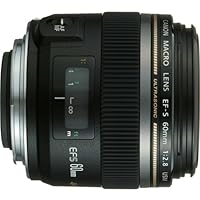
Canon EF-S 60mm f/2.8 Macro USM Lens for Canon SLR Cameras

Canon EF-S 60mm f/2.8 Macro USM Lens for Canon SLR Cameras
Customer Ratings: 5 stars
Buy Now
This was one of the first lenses that I purchased with my Rebel XT. Now after taking several thousand pictures with it I can honestly say it was well worth the cost. I very rarely have any unsharp pictures with this lens unless it is my own fault by trying to use too slow of a shutter speed without a tripod.

I also have the 180mm f/3.5L Macro Lens, which costs about 3 times more than this lens, and although it is very clear and the extra reach is nice at times especially since it can be used with both the 1.4X and 2X TC's, it is very difficult to use inside without a tripod. The 60mm can be handheld if needed with very good results even if you have to bump your ISO up a little to do so.

I have also used this lens for both inside and outside portrait work with very nice results.

All-in-all, given it's small size and light weight I very rarely leave this lens behind when I go out because you never know when you might see a great macro shot.

Click Here For Most Helpful Customer Reviews >>